

Logitech G560 gaming speakers review: The first truly useful RGB peripheral, but it’ll cost you - rodriguezworstaustany
RGB is the buzzword in peripherals these days, but a few have saved whatsoever historical use for them. Information technology's all intimately and good to have an RGB-enabled mouse or headset or keyboard, merely aside from a few gimmicks like "imitating the sirens in Grand Thievery Auto," it's still more most aesthetics than functionality.
Logitech's G560 changes that, using RGB LEDs in a path that feels transformative. If only the effect were paired with slightly better speakers.
IllumiRoom Redux
Way back in 2013 Microsoft showed turned footage of a image for the Xbox Ace, the "IllumiRoom." Emerging from Microsoft Research, IllumiRoom secure to make gaming more immersive away literally immersing you in it. Using a projector synced to your actualised TV, the end was to extend the picture off the screen and onto the surrounding walls.
This projecting section would search worse than the actual Television picture, rendered at lower quality to keep the frame grade impact minimal. Simply it wouldn't matter much—your incidental vision isn't rattling sensitive to contingent anyway. You'd feel as if the picture were untold bigger, wrapper around you.
It was a precooled idea that went nowhere. Maybe information technology be too such, or maybe the hit to performance wasn't worth it—specially along the already-struggling Xbox One. But for years now I've waited for mortal to take up the baton.
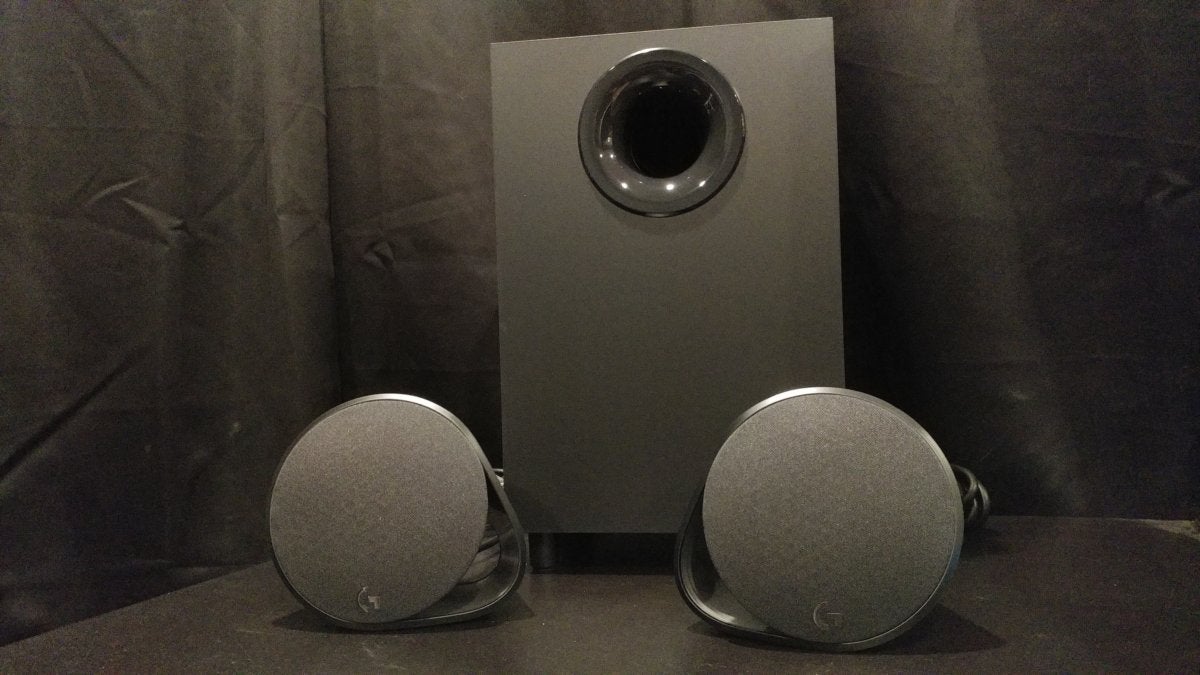
The G560 isn't IllumiRoom, but it's close. A 2.1 system, the G560 consists of two rounded satellite speakers and a monumental, vertically-oriented subwoofer. It's not as eye-catching perhaps as Harman Kardon's known SoundSticks, just it's standing a pretty attractive set symmetrical with the lights dimmed.
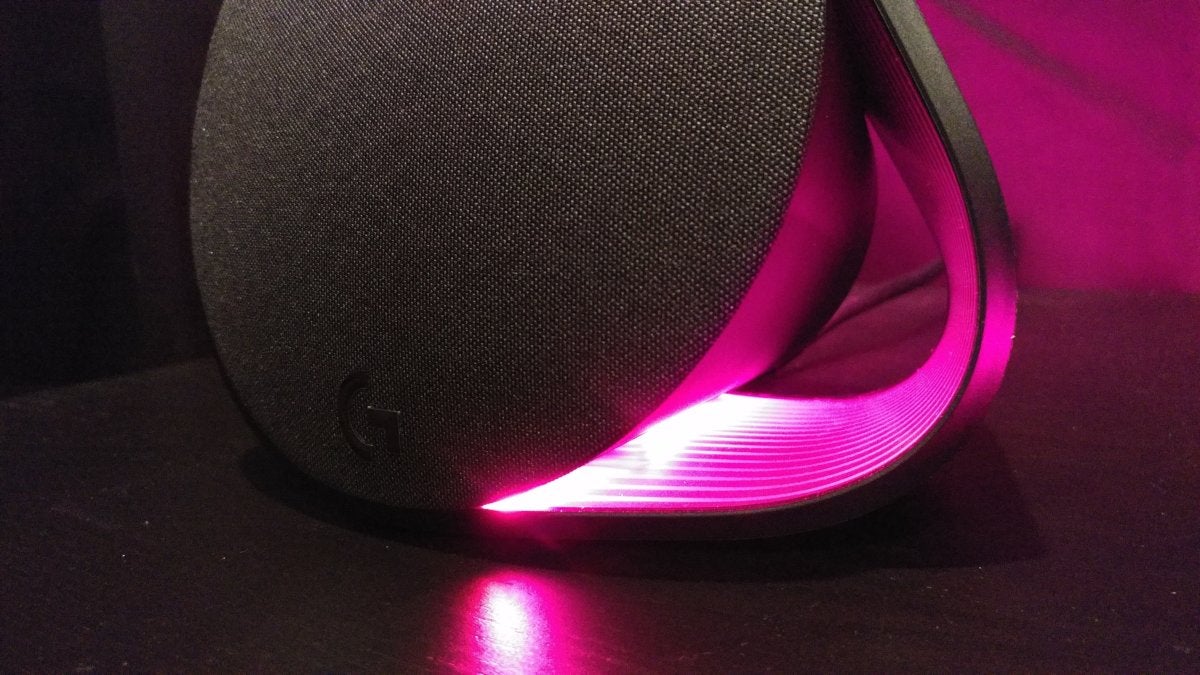
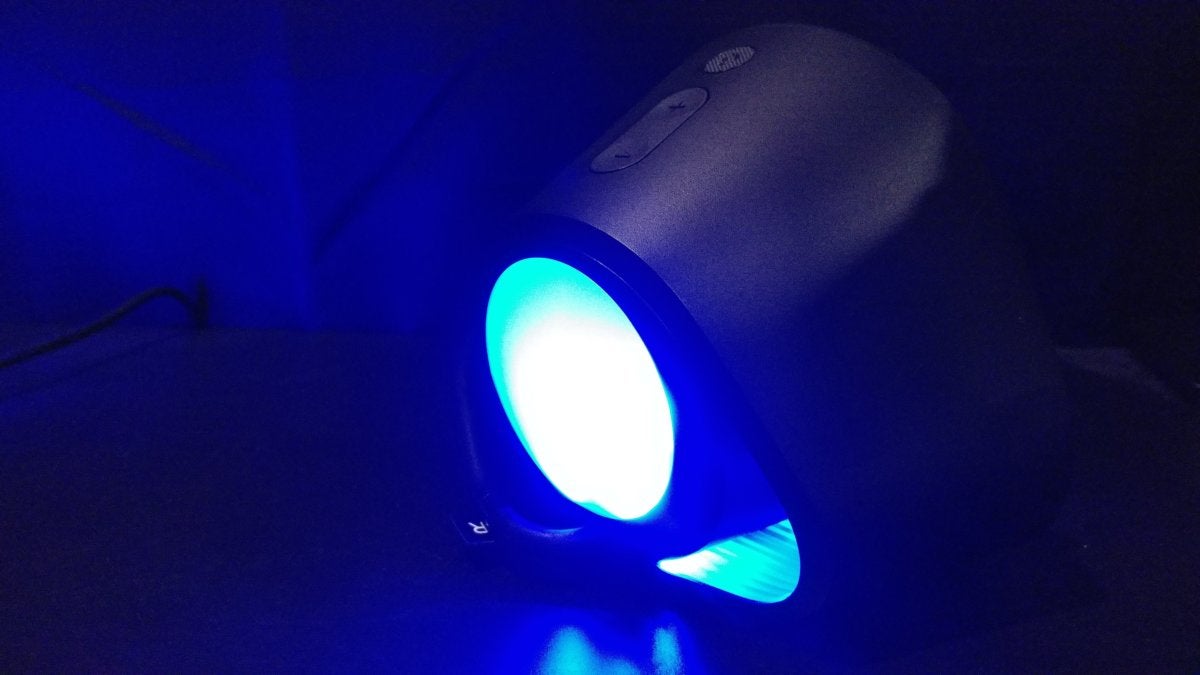
The G560's RGB ignition is key, though. Plug it in, and some the front and rear of each speaker illuminate. The front zone wraps around a cutout next to the Speaker, piece the rear is a larger and brighter light meant to diffuse crossways the wall behind your desk.
Arrayed properly, the G560 ends up acting a good deal like those ambient backlighting kits you can buy and stick to the back of your monitor. The nonremittal is an orange/blue color gradient seen in to the highest degree of the G560's marketing. You Crataegus oxycantha, of course of study, key in the regular lighting effects—static, brandish, rainbow, et cetera.
 IDG / Hayden Dingman
 But Logitech's real coup is a screen sampler.
I've complained about RGB firing for years, or rather the fractured nature of RGB lighting. Logitech has its SDK, Razer has another, SteelSeries has a 3rd, and so on. Information technology practically ensures your RGB peripherals will last out a freshness, because few game developers are going to bother implementing every last these different versions of the same idea. It's why we see companies competing for exclusives, like Razer with Overwatch or Logitech with Grand Stealing Auto V.
With the covert sampler, Logitech essentially bypasses this restraint. Sure, you tail still get better results by programming specifically for the G560's unique feature film nonmoving—but you lav get ahead perfectly passable results with no effort on the developer's part.
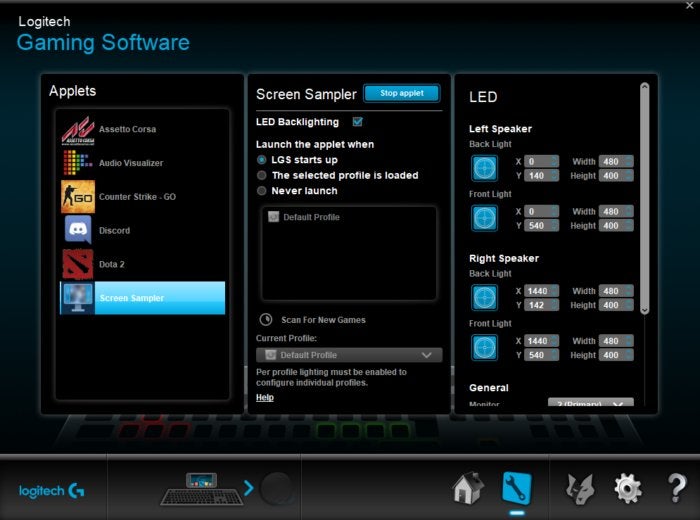
By default, the screen sampler keeps tabs happening the four corners of your screen. The bottom-left corner corresponds to the front-port lighting zone, top-left to the back-socialistic, and so on.
 IDG / Hayden Dingman
 It then averages all pixel values in this field to determine what lighting to use, here and now-to-moment. Let's say there's a nighttime scene with a fire pit in the bottom-left niche. In that scenario, the front-left lighting zone connected the G560 might glow orange, while the other three show a deep blue. The effect updates constantly, so if the camera panned crosswise the scene you power see the left zone sooner or later turn blue and the right turn around orangish, in line with the open fire.
It's not IllumiRoom. It's nowhere near as high-tech, nor is the effect as all-encompassing. But IT's amazing how much the effect adds to the feel for, especially at night. If I turn the speakers off I immediately notice the image on-screen feels smaller and more affected. I've even left the G560s plugged in and jetting while victimization a headset or some other pair of speakers, because once I tested the light effect I never wanted to go back.
It real is the front time I can say that about an RGB peripheral. Logitech and its peers consume always talked about keyboard inflammation contributive to immersion, binge comparable that—but I'm rarely if ever looking for at my keyboard piece gaming, and the backlighting isn't nearly bright adequate to indicate anything. The G560 is right in my line of business of sight, and the screen taster is intelligent adequate that it's contributed to really eerie moments in Shadow of the Tomb Freeboote, Portion 2, and a few other games this year with intense and purposeful ignition.
Nettle your neighbors
Unfortunately that lighting effect bequeath operate you quite an bit of money, relative to the sound quality. These are $200 speakers, which ISN't much if you compare them to a high-end 2.1 system, but it's a lot compared to your regular Microcomputer speakers. For that money you can get or s coagulated-sounding setups, including Logitech's own Z623, the Klipsch ProMedia 2.1, and the aforementioned Harman Kardon SoundSticks.
The G560 isn't bad, simply it doesn't outdo these other (often cheaper) options, at to the lowest degree to my ears.
 IDG / Hayden Dingman
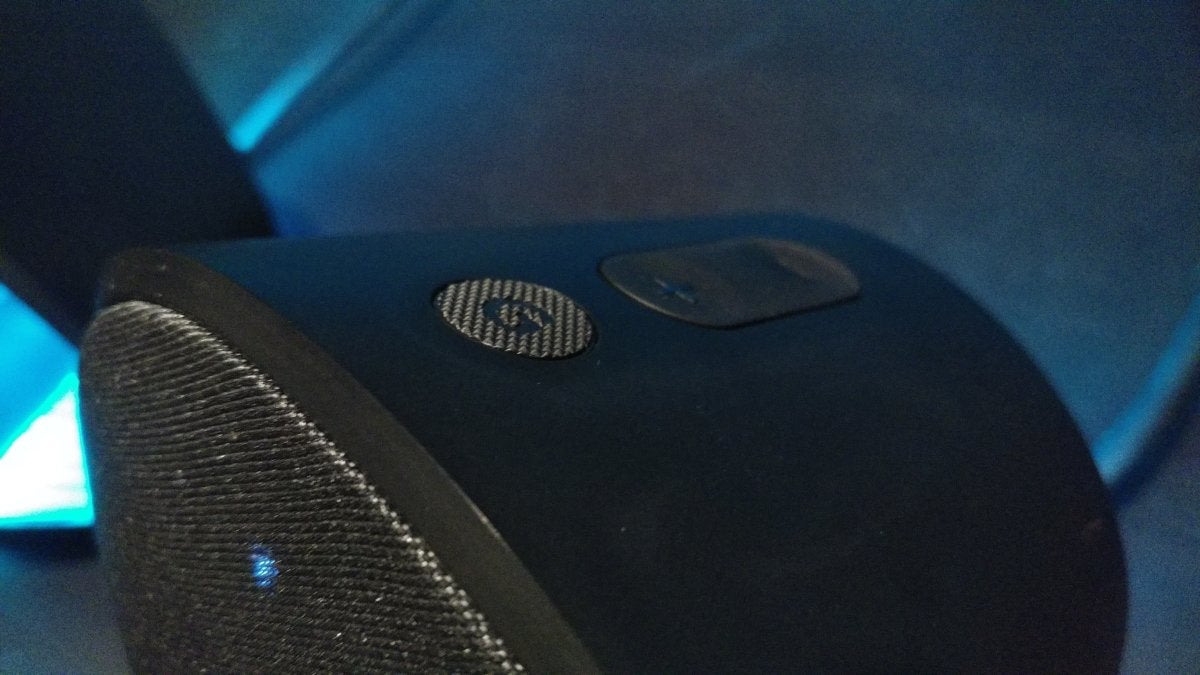
 Part of the problem is a wonky volume scaling algorithmic rule that still hasn't been fixed. Opening at "0," or muted, the G560's volume steps in essence run along: Quietest (2), Quieter (4), Quiet (6), Loud (8), Louder (10), and Deafening (12 – 100). The grading is all deplorable too, with exponential jumps between 4/6 and 8/10, meaning 8 is almost forever too stilly for what I'm trying to dress and 10 way as well loud.
I've held off reviewing the G560 for a some months, in function because Logitech told me this intensity grading supply would be solved by a firmware update over the summertime. In my see, it hasn't. There was a firmware update as promised, but the G560 tranquillise gets way too loud too archeozoic, making nearly 90 percent of its volume settings unusable.
There's a workaround. You can go into Logitech's software and drop all single Equivalent weight setting past about 20 decibels, giving you Thomas More headway to adjust volume. That scuffle shouldn't be on the end-user though, and so the Net is rife with complaints approximately the G560 being "too loud." Not a complaint I'm accustomed to visual perception with PC speakers, but it's fit here.
 IDG / Hayden Dingman
 The problem goes beyond your poor, deafened ears. At low volumes the G560 system sounds importantly worse than information technology truly is. It's completely controlled by bass, the subwoofer coming done way more than the two satellite speakers. Again, you could go into Logitech's software system and adjust the deep manually—but when you turn the loudness up, you'll then have an weak, shrill auditory sensation. The solution is just…never turn the speakers fallen that far.
Anyway, at an optimal volume—I guess "8" or "10" because anything else is too loud—the G560 sounds pretty decent. The subwoofer is powerful, evening shaking my desk along social function. If you like a beefy bass sound, this is a solid choice. The satellite speakers are also fairly good quality for a $200 2.1 setup, albeit a little thin and crowded-superficial at multiplication thanks to their small size.
Stereophonic response is great, with thoroughly left-right play and excellent center channel simulation. Stay out from the faux-7.1 surround though: In my experience it's bad mediocre in both euphony and games/films. It gives everything a "wide" feeling, but doesn't at all feel the like a proper 5.1 surround system. I could easy tell all sounds were still coming from the front.
 IDG / Hayden Dingman
 The bigger issue remains that you're paying a superior for the lighting. The Klipsch 2.1 setup I mentioned is the same price as the G560, and you'll lose impossible happening the RGB effect—but the Klipsch speakers sound better. Others, like Logitech's Z623, sound maybe a bit worse, but not enough that you're likely to notice, and that set costs half equally much.
In person I think the RGB lighting is worth the money, but it's decidedly a needless luxury. Those who honourable need utilitarian speakers believably won't want to spend this overmuch, while audiophiles will be let down by the G560 and choose for something better. IT's a weird oblivion to be in.
Bottom line
The bang-off IllumiRoom effect is really cool though. While I don't think the G560 is a essential-have loudspeaker system, I hope it's the first of many another products with ambient RGB lighting. I continue to play a ton of Lot 2, and it truly is a great showcase for the G560, the room all planet has a diametric colour scheme, or how so many areas have high-contrast shadowy areas with a few glistening lights. I suspect Doom would also be a great demo.
In any case, it's the first RGB device I've used that's enhanced my gaming experience someway, and that's saying a lot. I wish the tech were paired with a better set of speakers, or even a set of speakers without weird loudness quirks. Simply hey, a handful of annoyances haven't stopped me from keeping them connected my desk for the last six months, so Logitech clear did something right-hand.

Source: https://www.pcworld.com/article/402789/logitech-g560-review.html
Posted by: rodriguezworstaustany.blogspot.com
0 Response to "Logitech G560 gaming speakers review: The first truly useful RGB peripheral, but it’ll cost you - rodriguezworstaustany"
Post a Comment